Introduction
The worldwide building sector is facing a significant shift. For long, the main materials of construction have been brick and concrete, and they are still responsible for most of single houses, roadways, and other infrastructures. The same materials which constructed modern cities also created some problems in the realms of time, efficiency, and environmental impact.
In many parts of the world, revolution has come about in the use of sustainable building materials which have replaced the traditional brick and concrete. The main driving force behind this change is the demand for rapid construction, better resource management, and the incorporation of high-tech building solutions. The consideration of reduced waste, enhanced speed, and long-term performance in modern construction has become the norm.
FRBL is the trailblazer in this revolution. Their traditional construction processes being replaced by modern and environmentally friendly practices, the company collaborates with homebuilders, developers, and construction experts to produce buildings that are not only of good quality but also cheaper, faster, and more intelligent by adapting the latest building methods.
Why the Construction Industry Is Moving Away from Brick and Concrete?
The global construction industry is undergoing a major transition. Brick and concrete have been the primary materials of construction for many years, and they still account for the majority of single houses, roadways, and other structures. The same materials that built modern cities also gave rise to some issues in the areas of time, efficiency, and environmental impact.
In many parts of the world, revolution has come about in the use of sustainable building materials which have replaced the traditional brick and concrete. The main driving force behind this change is the demand for rapid construction, better resource management, and the incorporation of high-tech building solutions. The consideration of reduced waste, enhanced speed, and long-term performance in modern construction has become the norm.
FRBL is the pioneer company in this revolution. With its advanced and eco-friendly building solutions, FRBL enables the homebuilders, the developers, and construction professionals to build better, faster, and smarter while also ensuring that the quality is not compromised, by applying the latest building techniques.
Modern Construction Methods Reshaping Building Construction
Modern construction emphasizes precision, speed, and consistency. Off-site manufacturing and system-based construction methods are now widely adopted in housing and infrastructure development.
FRBL integrates advanced building technology with sustainable building materials to support rapid construction without compromising structural integrity. This approach reduces dependency on traditional brickwork and allows builders to meet tight timelines efficiently.
What Defines Sustainable Building Materials?
The sustainable building materials’ life cycle includes the efficient utilization of the materials in all steps. It means that the processes of making, transporting, installing, using, and maintaining, in general, have to be more or less efficient for a long period.
The key components are:
- Raw materials’ maximum usage
- Building materials’ minimum waste
- Construction methods’ compatibility
- Proper time for installation during the construction process
- The entire building’s life-span of strong quality and durability
FRBL has produced their construction materials according to these criteria, thus they are the solution for all types of constructions like single-family homes, large-scale residential projects, and even infrastructure works.
Traditional Materials vs Sustainable Building Materials
| Aspect | Brick & Concrete | Sustainable Building Materials (FRBL Systems) |
| Construction Speed | Slow, labor-intensive | Fast and system-driven |
| Site Waste | High | Minimal |
| Construction Process | Multiple stages | Streamlined installation |
| Design Flexibility | Limited | High |
| Suitability for Modern Construction | Low | Very High |
Modern Construction Methods Reshaping Building Construction
In today’s construction world, there are three prime factors – precision, speed, and consistency. Off-site building processes and manufacturing to a great extent have made it possible for all sorts of construction works from houses to infrastructures to be done quickly and efficiently.
The use of radical technology and eco-friendly materials in FRBL guarantees not only strength of the structure but also a speedy construction process that consumes lesser smokes and bricks. Therefore, the installer will complete his work of high quality at the scheduled time or even before that.
Gypsum-Based and Panelized Systems in Modern Building Use
In today’s world, panelized and gypsum-based systems are the most critical materials in the construction of modern buildings. These materials are processed with an emphasis on accuracy and simple installation.
The diverse panel systems manufactured by FRBL decrease the complexity on the site, enhance the quality of the finish, and align perfectly with the services. Thus, being very suitable for the construction of houses, residential buildings, and also infrastructural works.
Chart Explanation: Time Savings in Construction
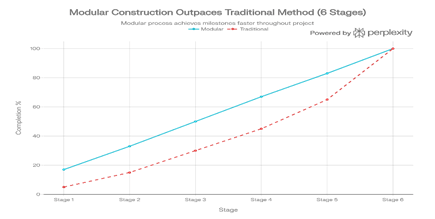
Traditional construction shows gradual progress, while FRBL-based construction demonstrates a steeper curve, indicating faster construction and earlier completion.
This time efficiency is one of the strongest reasons builders and home builders are shifting toward sustainable building materials.
The Role of Sustainable Building Materials in Faster Project Delivery
The escalating demand for swifter project delivery has been one of the major transformations in contemporary construction. The traditional method of constructing buildings comprises several stages, which are greatly reliant on factors like weather, the availability of skilled labor, and curing period. Such factors render the timelines uncertain, particularly in case of extensive housing and residential projects.
The use of environmentally friendly building materials accelerates the construction process, as it moves a lot of the work from the site to the factory, where the conditions are better controlled. Consequently, the accuracy and consistency of the building materials produced will enable them to be assembled very quickly at the site. Thus, fast construction is possible to be achieved without any trade-off on structural performance or finishing quality.
FRBL is the one that backs this transition by providing materials that are specially made to support rapid construction processes. FRBL systems, moreover, by lessening on-site works and bettering the teamwork between design and execution, aid the home builders in meeting their tight schedules while still keeping the construction standards high.
Role of FRBL in Housing and Residential Construction
The demand for housing worldwide continues to grow, and therefore the building methods of today must be based on a new way of thinking which involves speed, quality, and uniformity.
FRBL is a manufacturing company that provides building materials and works with the housing construction sector, granting:
- Shorter construction times
- Improved workmanship
- Easier construction
- Flexibility in design and changes in the future
Through simple house plans, FRBL systems help the builders in completing the entire process of construction in a modern and efficient way without being a burden on the budget and time taken.
Improving Construction Quality Through System-Based Building
Traditional construction methods pose a big problem to quality control. Brickwork and concrete work depend largely on the skill of the workers, thus, different parts of the building may have different quality. This inconsistency is more obvious in huge residential projects or multi-unit houses.
System-based construction materials enhance quality to a better level by bringing in standardization to the industry. The parts are produced with specific requirements, making sure they all have the same strength, are in the same alignment and have the same surface finish. The consistency in this process helps to reduce rework and it ultimately results in better performance of the entire building.
The way FRBL thinks when it comes to eco-friendly building materials is accuracy and dependability. As a result of combining modern technology with engineered materials, FRBL can make the construction of buildings that meet current quality standards not only in housing but also in infrastructure and shed projects.
Infrastructure and Large-Scale Construction Benefits
Efficiency, reliability, and scalability are the major demands of infrastructure projects. Sustainable building materials of FRBL facilitate very high production rate and prompt assembly, thus making them apt for bigger establishments and industrial sheds.
Safer construction areas are resulting from lesser on-site labor, and there is also improved coordination among different teams.
Addressing Durability and Performance Concerns
One of the most frequently asked questions that arise in the transition from traditional construction materials like brick and cement to eco-friendly ones is durability over time. FRBL’s sustainable building materials are subjected to a series of tests for their performance and their proper manufacture is strictly controlled, which are the two major aspects of standardization in the industry.
The quality and reliability of these materials have been established for contemporary construction and are applicable through residential and infrastructure developments without risking structural integrity.
Enhancing Efficiency Across the Construction Process
The term “efficiency in construction” has changed its meaning and is now used to describe not only the speed of the construction process but also the effective coordination and the improvement of resources together with the reduction of waste as well. The conventional construction methodologies frequently depict a picture of the process which is very much characterized by interdependence of tasks creating delays, constant moving around of materials leading to overruns and wasting of materials.
Green building materials are an instance of such a process happening since they simplify the construction process by the very nature of being difficult to manage. With less work going on at the site and the phases of installation being very clear, the project is much simpler to control. This situation is especially true in the case of constructing houses and projects of small houses where the demand for transparency and the need for reliable time schedules are the main concerns of homeowners.
Supporting Long-Term Performance in Housing and Infrastructure
Besides construction speed and efficiency, long-term performance is of major importance in the materials selection. Buildings have to endure daily use, exposure to the outside environment, and alteration of their function over the years.
Sustainable building materials are designed to provide dependable performance for the entire lifecycle of the building. Their constant quality leads to less maintenance and keeps both housing and infrastructure projects durable. This means that they are a smart choice for contemporary building construction.
FRBL takes into account the long-term usability of its building materials as well as the modern building technologies in its designs. This guarantees that infrastructures will be adaptable, efficient, and in line with the current construction standards as they continue to change.
Meeting Modern Expectations in House Construction
Residential construction today is evolving the way we live. Homebuyers demand efficient layouts, clean finishes, and the option to alter spaces in the future. Such adaptability can be made unnecessarily hard and costly by traditional construction methods.
Using sustainable building materials is easier to design for change and make alterations in the future without major works. This is particularly useful for independent house projects due to its long-term usability.
The FRBL solutions enable smarter building for modern housing requirements for better performance, efficiency and adaptability. Through this method, home builders can create homes that are equipped for tomorrow and meet today’s needs.
Future of Modern Construction
The upcoming era in construction will be dominated by systems that manage efficiently the three aspects of speed, sustainability, and performance. While the contemporary construction will keep on changing the sustainable construction materials will be the ones to displace the classic ones like the brick and concrete in residential, public, and business projects areas.
FRBL is supporting this transition with its advanced building materials that meet the modern construction practices and worldwide construction demands thus it becomes a part of the key enabler.
Conclusion
The construction industry’s move away from bricks and concrete is an actual problem, not a question of style and fashion. The incorporation of green building materials in construction speeds up the construction process and increases efficiency and compatibility with modern building technology.
Without any doubt FRBL is a key player in the construction industry for supplying dependable, sustainable and efficient building materials. FRBL systems, which are increasingly used in a variety of construction types across global markets. From single-family houses and independent homes to larger residential projects and infrastructural schools.
The construction industry’s future will still be shaped by the combination of building materials and building technology since these two will be the one defining how the industry will be building.